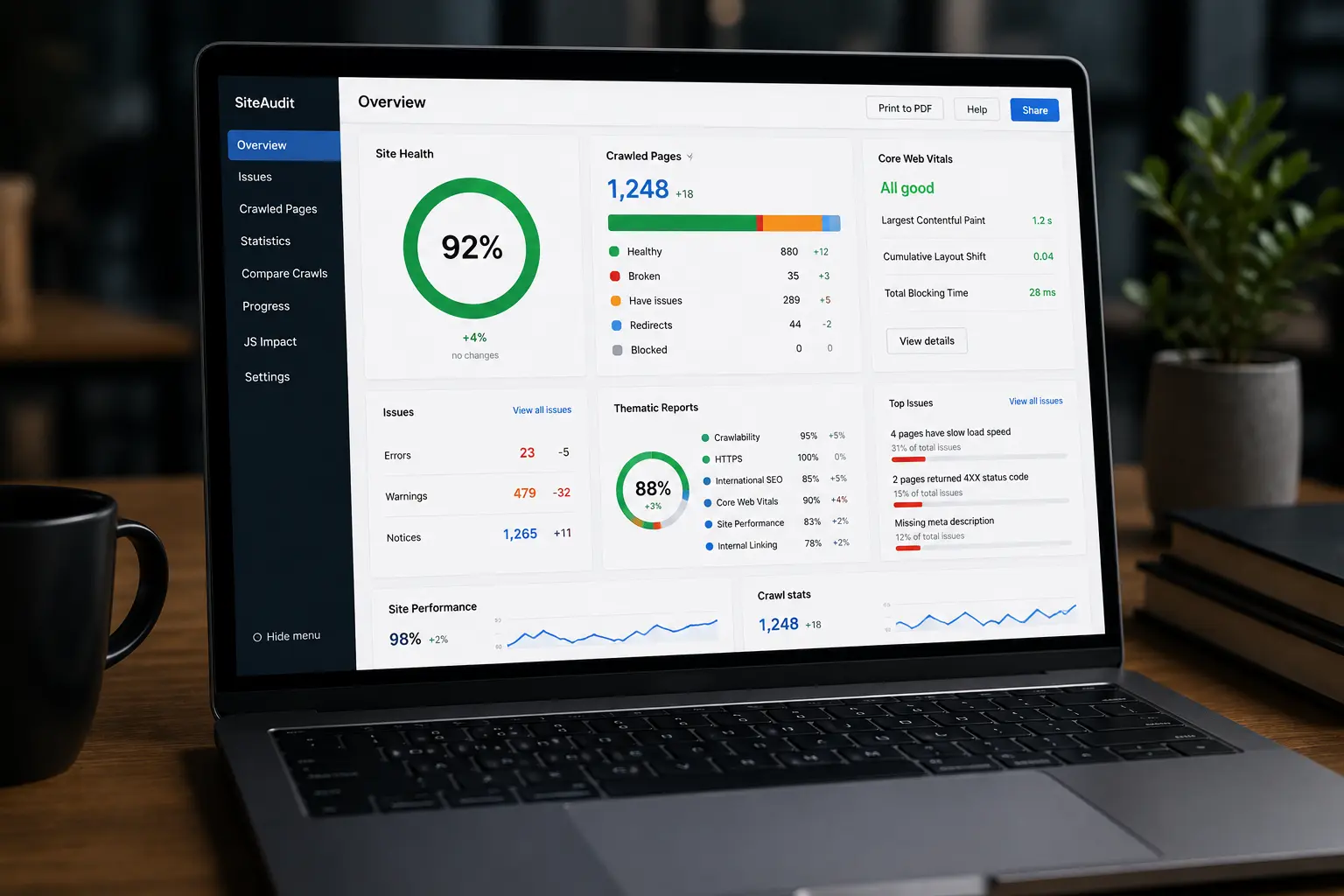
The Ultimate Website Health Checklist for 2026
A website health checklist for 2026 covers six core areas: technical SEO, Core Web Vitals, mobile usability, on-page content quality, security (HTTPS & malware), and backlink profile. Indian businesses that regularly audit these factors rank higher on Google, attract more qualified traffic, and convert better. This guide gives you a practical, step-by-step framework — whether you manage a startup site, an e-commerce store, or a corporate web presence.
1. Technical SEO Audit
Technical SEO forms the foundation of every healthy website. Without a crawlable, indexable site, your content — no matter how well-written — will not rank. For Indian businesses competing in high-volume verticals like real estate, healthcare, and edtech, technical issues are often the silent traffic killers.
| Checklist Item | Tool to Use | Priority |
|---|---|---|
| XML Sitemap submitted to GSC | Google Search Console | High |
| Robots.txt not blocking key pages | Screaming Frog | High |
| No 4xx / 5xx crawl errors | Ahrefs / GSC | High |
| Canonical tags set correctly | Screaming Frog | Medium |
| Structured data / Schema markup valid | Google Rich Results Test | Medium |
2. Core Web Vitals & Page Speed
Google’s page experience signals continue to influence rankings in 2026. The three Core Web Vitals — LCP (loading), INP (interactivity), and CLS (visual stability) — must all score in the “Good” range. Indian sites hosted on shared servers or loading heavy Devanagari/regional fonts are especially vulnerable to poor LCP scores.
Key actions: compress images to WebP format, defer non-critical JavaScript, use a CDN (Cloudflare has a free tier), enable browser caching, and remove unused CSS. WordPress users should evaluate whether their current theme is bloated — many popular Indian agency themes carry 200KB+ of unused CSS.
3. Mobile Usability
With over 91% of Indian internet users on mobile, Google’s mobile-first indexing is not optional — it is the default. Your mobile experience defines how Google evaluates your entire site. Run Google’s Mobile-Friendly Test and check for tap target sizes (minimum 48×48 px), readable font sizes (minimum 16px body text), and no horizontal scrolling.
Also audit your site on low-end Android devices common in Tier-2 and Tier-3 Indian cities. A site that loads beautifully on an iPhone may stutter on a ₹8,000 device with a 4G connection on a congested tower.
4. On-Page SEO & Content Quality (E-E-A-T)
Google’s E-E-A-T framework — Experience, Expertise, Authoritativeness, Trustworthiness — has grown more important since the 2024–2026 Helpful Content updates. For Indian YMYL (Your Money Your Life) sites covering finance, health, or legal services, E-E-A-T signals can make or break rankings.
Your on-page checklist should include: unique, well-researched title tags (under 60 characters), compelling meta descriptions (under 155 characters), H1–H3 hierarchy with semantic keyword distribution, internal linking to topically related pages, and author bios with verifiable credentials. Avoid thin content pages with under 300 words — Google’s AI Overviews tend to pull from comprehensive, well-structured sources.
📖
Further Reading: Google’s official Search Quality Evaluator Guidelines outline exactly how human raters assess E-E-A-T signals on your site.
Read Google’s Search Quality Evaluator Guidelines (Official PDF) →
5. Website Security Checklist
Security is a trust signal for both users and Google. A hacked Indian e-commerce site can lose 60–70% of organic traffic within days. Your 2026 security checklist must include: valid SSL certificate (HTTPS), Web Application Firewall (WAF) enabled, WordPress core + plugins updated within 48 hours of security patches, two-factor authentication on admin accounts, and regular malware scans via tools like Sucuri SiteCheck.
6. Backlink Profile Health
A toxic backlink profile can trigger manual or algorithmic penalties. Audit your link profile quarterly using Ahrefs or Google Search Console’s Links report. Disavow spammy links from irrelevant, low-DA Indian blog networks or foreign PBNs. Focus on earning contextual backlinks from authoritative Indian media, trade publications, and government portals (.gov.in and .edu domains carry strong trust signals locally).